

The quality of precision tweezers determines whether a surface-mount component lands perfectly on its pads or goes flying across the workbench. For electronics repair, the right tweezers are not a luxury — they are the primary interface between your hands and components measured in fractions of a millimeter, and the wrong material or tip geometry makes accurate placement genuinely difficult regardless of skill level. Anti-static protection, non-magnetic properties, heat resistance, and tip alignment under spring tension are the specifications that separate workbench-grade tools from consumer alternatives.
After testing these tools across circuit board rework, SMD component placement, jewelry setting, and precision assembly work, we identified five products from AliExpress that deliver professional-level performance at accessible prices in 2026. The selection covers the full range of materials and applications — from ceramic-tip ESD tools for high-heat soldering environments through to Rhino SW Series Japanese precision tweezers for the most demanding fine-pitch IC work.
Whether you are a professional repair technician, a hobbyist building electronics projects, or a jeweler working with small stones, this guide matches the right tool to your specific bench requirements.
Quick Comparison: Top 5 Precision Tweezers from AliExpress
Ceramic-Tip Stainless Steel Tweezers

Titanium Alloy Precision Tweezers
Stainless Steel Adjustable Lock Tweezers

Industrial Grade IC & PCB Tweezers

Rhino SW Series Japanese Precision Tweezers
Detailed Specifications Comparison
| Specification | Ceramic-Tip Tweezers | Titanium Alloy | Adjustable Lock | IC & PCB Grade | Rhino SW Series |
|---|---|---|---|---|---|
| Material | Stainless Steel + Ceramic tips | Titanium Alloy | Stainless Steel | Industrial Stainless Steel | Anti-Magnetic Alloy |
| ESD Protection | Yes — non-conductive tips | Yes — anti-magnetic | Anti-static coating | Standard | ESD Certified |
| Anti-Magnetic | Yes — ceramic tips | Yes — titanium | No | No | Yes |
| Heat Resistance | High — ceramic insulates | High | Standard | High | Standard |
| Locking Mechanism | No | No | Yes — slide-lock buckle | No | No |
| Tip Type | Ceramic precision tips | Precision pointed | Fine-point precision | High-tension fine tips | Micro-fine straight ESD |
| Finish | Standard | Fingerprint-free | Standard | Anti-fingerprint | Non-glare matte |
| Best For | Hot air + soldering work | Motherboard repair | Jewelry + diamond setting | IC + PCB rework | Fine-pitch ESD components |
| Rating | 4.7/5 | 4.8/5 | 4.6/5 | 4.6/5 | 4.8/5 |
Detailed Reviews: Top 5 Precision Tweezers from AliExpress
Ceramic-Tip Stainless Steel Tweezers — Best for Soldering
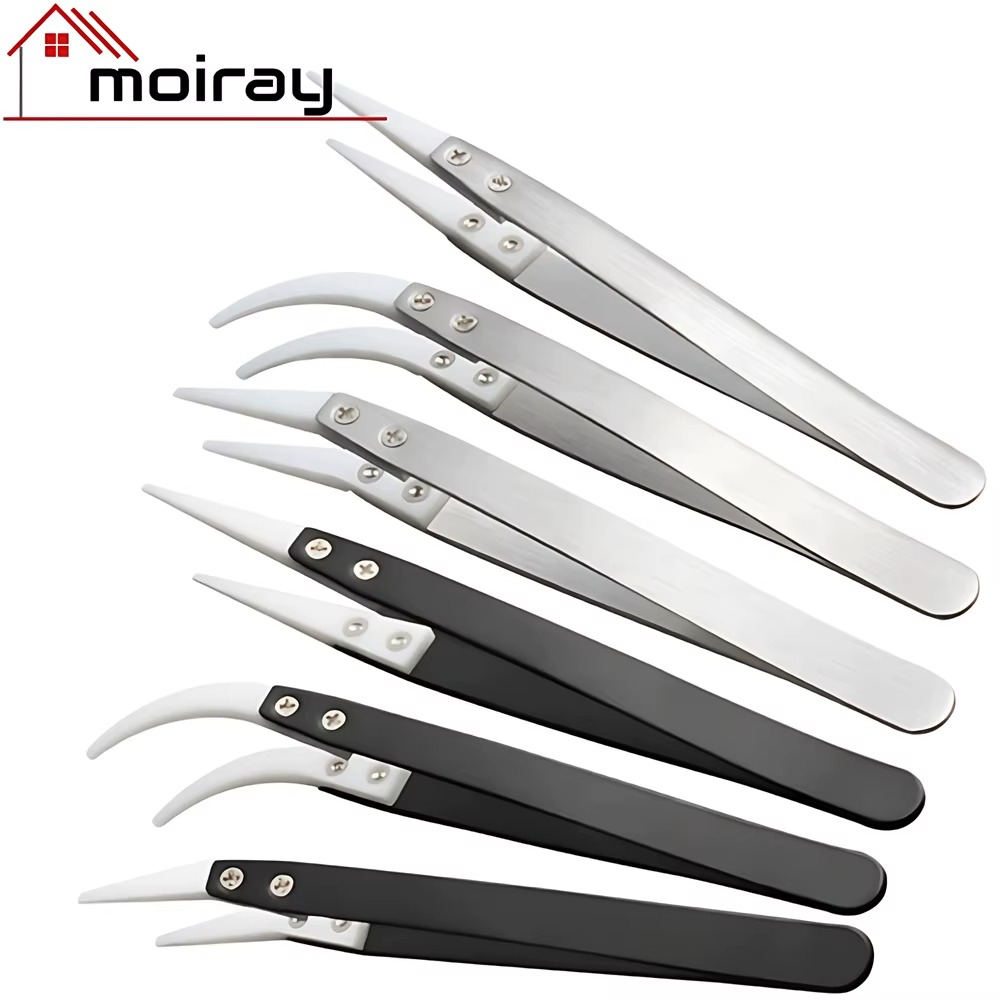
The Ceramic-Tip Stainless Steel Tweezers earn the Best for Soldering position because they solve a specific and important problem with standard metal tweezers in hot work environments. Standard steel tweezers conduct heat efficiently — which means that when holding a component with a hot air rework station nearby, heat travels up the tips into the body and toward your fingers, while the component itself may be subjected to conducted heat that can damage it or dislodge it from position. Ceramic is a thermal insulator, so these tips do not transfer heat in either direction, protecting both the component and the user during extended rework sessions.
The non-conductive ceramic tips also provide ESD safety in the most direct form possible — the tips themselves cannot carry a charge to a sensitive component, regardless of whether the user is fully grounded. For handling sensitive ICs, MOSFET gates, and fine-pitch components near live circuits, non-conductivity at the tip is meaningfully more protective than relying solely on operator grounding. The non-magnetic properties of ceramic make these the correct choice for work near magnetism-sensitive components such as Hall-effect sensors and certain MEMS devices.
The brittleness of ceramic tips requires appropriate care — they will chip or crack if dropped onto a hard surface or used for any prying or lateral force application beyond gentle component guidance. These are placement and holding tools, not manipulation tools, and treating them as such ensures a long service life.
Key Specifications
- Tip Material: Ceramic — non-conductive, non-magnetic, heat-insulating
- Body Material: Stainless steel — durable ergonomic handle
- ESD Protection: Yes — non-conductive tips prevent charge transfer to components
- Heat Resistance: High — ceramic does not transfer heat from soldering environments
- Anti-Magnetic: Yes — ceramic tips safe near magnetism-sensitive components
- Limitation: Ceramic tips are brittle — avoid drops and lateral force application
Best Use Cases
- Hot air rework station work where tip heat conductance would damage components
- Holding SMD components in position during reflow soldering
- Working near live circuits where non-conductive tips prevent shorts
- Handling magnetism-sensitive components including Hall-effect sensors
- BGA reballing and chip-level rework with hot air
- Any soldering environment where standard metal tweezers create thermal or conductance risk
Titanium Alloy Precision Tweezers — Editor’s Choice
Titanium Alloy Precision Tweezers earn our Editor’s Choice as the best all-round precision tweezers for professional electronics repair work. Titanium’s combination of properties makes it the ideal material for this application in a way that no single alternative matches: it is substantially lighter than stainless steel (reducing hand fatigue over long repair sessions), harder and more resistant to deformation under repeated use, naturally anti-magnetic (critical near sensitive ICs and storage devices), highly resistant to corrosion from flux and cleaning solvents, and it maintains tip alignment under spring tension through more use cycles than standard steel alternatives.
The anti-magnetic property deserves particular emphasis for professional repair work. Magnetic fields affect hard drive read heads, magnetic sensors, certain capacitors in switched-mode power supplies, and other components where exposure to a magnetized tool during handling can cause latent damage or functional issues. Standard steel tweezers magnetize through repeated use and may not be obviously magnetic to the user while still affecting sensitive components. Titanium does not magnetize — the protection is inherent and permanent rather than dependent on the tool’s history or condition.
The fingerprint-free surface treatment maintains a clean, professional appearance across sessions and prevents oil deposits from transferring from the tool to circuit board surfaces where they can interfere with soldering and cause flux adhesion issues. The higher cost compared to steel alternatives reflects the material’s superior performance properties — for technicians who use tweezers daily, the investment is repaid through longevity and reduced component damage over time.
Key Specifications
- Material: Titanium alloy — lighter and harder than stainless steel
- Anti-Magnetic: Inherent — titanium does not magnetize under use
- Corrosion Resistance: High — resists flux, solvents, and cleaning chemicals
- Finish: Fingerprint-free treatment — prevents oil transfer to board surfaces
- Weight: Substantially lighter than steel — reduces hand fatigue in long repair sessions
- Limitation: Higher cost than steel alternatives — cosmetic surface scratches over time
Best Use Cases
- Motherboard repair requiring anti-magnetic tool safety near storage and sensor components
- Smartphone and tablet micro-soldering requiring lightweight precision tools
- Extended repair sessions where steel tweezer weight creates cumulative hand fatigue
- Handling small screws, cables, and flex connectors in confined device interiors
- Work near hard drives, magnetic sensors, and storage-sensitive components
- Professional repair technicians investing in tools that last through years of daily use
Stainless Steel Adjustable Lock Tweezers — Best for Jewelry
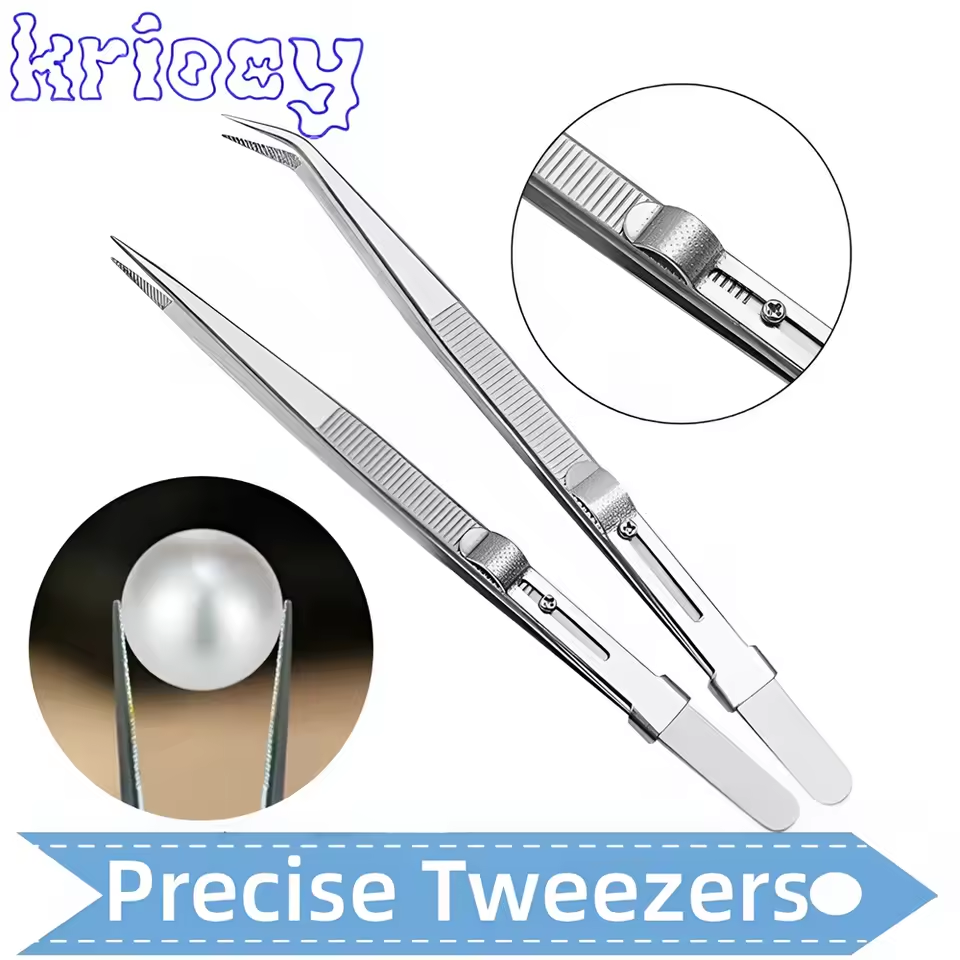
The Stainless Steel Adjustable Lock Tweezers earn the Best for Jewelry position because the slide-lock mechanism addresses the fundamental ergonomic challenge of precision setting work: maintaining constant gripping force on a small stone or component for extended periods without hand fatigue. Standard spring tweezers require continuous finger pressure to maintain the grip — over a long setting session, the hand muscles fatigue, grip pressure becomes inconsistent, and the risk of stones shifting or being released accidentally increases. The slide-lock buckle allows the grip tension to be set and locked, providing constant, consistent holding force without any muscle effort from the user.
Anti-static coating prevents the charge buildup that causes small lightweight stones and components to move unpredictably due to electrostatic attraction. In diamond and faceted gemstone setting, a stone that shifts due to static at the moment of setting a prong creates a misalignment that must be corrected — prevention through anti-static tooling is more reliable than correction after the fact. The fine-point precision tips allow access to the precise placement positions required for prong setting, bezel work, and component placement in tight mounting configurations.
The locking mechanism may feel slightly stiff during the first few uses as the adjustment slides through its initial break-in, but it functions smoothly thereafter. These tweezers are not designed for heavy-duty gripping or mechanical manipulation — they are precision holding tools for tasks that require hands-free static grip on small objects.
Key Specifications
- Locking Mechanism: Slide-lock buckle — adjustable tension, hands-free operation
- Material: Stainless steel — durable and corrosion resistant
- Anti-Static: Coating prevents static charge from shifting lightweight stones and components
- Tips: Fine-point precision for prong setting and tight placement positions
- Ergonomic Benefit: Lock eliminates continuous finger pressure — reduces hand fatigue
- Limitation: Not suitable for heavy-duty gripping or mechanical manipulation tasks
Best Use Cases
- Diamond and gemstone setting requiring locked constant grip during prong work
- Jewelry assembly where stones must be held steady for extended positioning periods
- SMD component placement where hands-free locked grip enables soldering with the other hand
- Any precise placement task requiring consistent grip force without continuous hand pressure
- Watch repair and micro-assembly where static buildup can displace small parts
- Craft and model making requiring stable hands-free holding during adhesive application
Industrial Grade IC & PCB Tweezers — Stainless Steel
The Industrial Grade IC and PCB Tweezers occupy the workbench position where the requirements are daily professional volume, chemical exposure, and mechanical durability rather than the anti-magnetic premium of titanium or the heat protection of ceramic tips. Industrial-grade stainless steel delivers higher tensile strength and better resistance to deformation than consumer-grade alternatives, maintaining tip alignment and spring tension through the repeated cycles of high-volume repair and assembly work. For technicians running through dozens of board repairs per day, this durability directly affects how long the tool performs before tips bend out of alignment.
The anti-fingerprint finish serves both cleanliness and professional workflow purposes. Fingerprint oils on tweezer tips transfer to circuit board pads and component surfaces, where they interfere with solder adhesion and cause flux residue to adhere more aggressively — creating cleaning work that clean tools would not generate. The high-tension tips provide firm grip on fine IC pins and small components with less risk of the component slipping from the tips during placement, which is the difference between a clean placement and a component landing across two pads and requiring rework.
The slight additional weight compared to titanium or ceramic alternatives reflects the denser industrial steel construction — not a significant factor for most users, but worth noting for repair technicians with hand fatigue concerns from extended daily use. For the majority of IC socket work, through-hole manipulation, and general PCB component handling, this tool provides excellent working performance at a price that makes keeping multiple sets on the bench practical.
Key Specifications
- Material: Industrial-grade stainless steel — higher tensile strength than consumer alternatives
- Finish: Anti-fingerprint — prevents oil transfer from tips to board surfaces
- Tips: High-tension precision tips — firm grip on IC pins and fine-pitch components
- Chemical Resistance: Excellent — handles flux, solvents, and isopropyl alcohol exposure
- Durability: Industrial rating — maintains tip alignment through high-volume daily use cycles
- Limitation: Heavier than titanium alternatives — greater hand fatigue in extended sessions
Best Use Cases
- High-volume IC and PCB component placement requiring durable daily-use tools
- Circuit board rework in environments with frequent flux and solvent exposure
- Fine-pitch IC pin manipulation where high-tension tip grip prevents slipping
- Production assembly environments requiring industrial-grade durability across many cycles
- Any bench work where anti-fingerprint tip cleanliness affects solder quality
- Backup or supplemental tweezers in a professional repair kit alongside titanium alternatives
Rhino SW Series Japanese Precision Tweezers — Premium Choice
The Rhino SW Series Japanese Precision Tweezers earn the Premium Choice position as the most precise and best-certified tool in this comparison. Japanese tool manufacturing maintains tolerances at the tip closure level that European and Asian commodity production does not consistently achieve — the tips close with micro-fine alignment that allows reliable contact with 0201 and smaller passive components, and the perfect closure under spring pressure means that a component gripped by these tweezers will not shift or fall between the tips during placement. For technicians working at the limits of hand-placed SMD work, this tip precision is the difference between consistent placements and repeated adjustments.
The ESD certification is formal rather than claimed — independently verified to meet ESD protection standards for handling sensitive components. The anti-magnetic alloy prevents the magnetization issues of standard steel, and the non-glare matte finish eliminates the reflection from polished stainless that creates eye strain under work lights during extended fine-work sessions. These details reflect a tool designed by people who actually use precision tweezers professionally, rather than a specification sheet optimization.
The higher price and the care required to maintain fine tip integrity are the expected trade-offs for the precision these tweezers deliver. Fine tips must be stored in a case or holder that protects the tip from contact with other tools or hard surfaces. For technicians whose work regularly pushes the limits of fine-pitch component handling, the Rhino SW Series is the correct investment — for occasional home repair use or general component work, the titanium or industrial grade alternatives deliver adequate precision at lower cost.
Key Specifications
- Origin: Japanese manufacturing — precision tolerances at tip closure level
- ESD Protection: Independently certified — formal verification not marketing claim
- Material: Anti-magnetic alloy — resists magnetization inherently
- Tip Precision: Micro-fine — capable of reliable 0201 and smaller component handling
- Finish: Non-glare matte — reduces eye strain under work lights in extended sessions
- Limitation: Higher price and fine tips requiring protective storage between uses
Best Use Cases
- Fine-pitch 0201 and smaller SMD component placement requiring micro-level tip precision
- ESD-certified handling of sensitive components in formal ESD-controlled environments
- Extended fine work sessions under work lights where matte finish reduces eye strain
- Professional repair technicians who demand the highest available tip alignment quality
- Handling CMOS sensors, MEMS devices, and components sensitive to both ESD and magnetic fields
- Microscope-assisted soldering work where tip precision determines placement quality
Precision Tweezers Buying Guide 2026
Choosing the right precision tweezers depends on understanding which material properties and features matter for your specific work — and which add cost without adding value for your use case.
Material Selection — What Actually Matters
Stainless steel is the baseline material for precision tweezers — durable, corrosion-resistant, and available at accessible prices. Industrial-grade variants maintain tighter tip tolerances through more use cycles than consumer-grade steel. Titanium adds meaningful upgrades over steel: lower weight, permanent anti-magnetic properties, and greater hardness that preserves tip geometry longer. The anti-magnetic advantage is not cosmetic — standard steel tweezers magnetize through repeated use and can affect sensitive components invisibly. Ceramic tips provide the only non-conductive, non-magnetic, heat-insulating option — the correct choice for hot air rework environments where metal tips create thermal and conductance risks. Japanese-manufactured alloys achieve tip closure tolerances that production-optimized alternatives cannot consistently match for the finest component work.
ESD Protection — Understanding What It Means
ESD (Electrostatic Discharge) protection in tweezers comes in several forms that vary significantly in actual effectiveness. Non-conductive ceramic tips provide intrinsic ESD safety at the contact point regardless of operator grounding. Anti-magnetic titanium alloy prevents charge accumulation from magnetization. ESD-certified tools like the Rhino SW Series have been tested and verified to meet discharge protection standards. Standard steel tools with no ESD designation can carry and transfer static charges that damage sensitive CMOS, MOSFET gate, and fine-geometry semiconductor components — damage that may not be immediately visible but causes latent failures later. For hobbyist work on robust components, standard steel is adequate. For professional work on CMOS image sensors, microcontrollers, and fine-geometry ICs, verified ESD protection is worth the investment.
Tip Type and Application Matching
Straight pointed tips are the most versatile — suitable for SMD placement, component handling, and general precision work. They provide direct visual access to the placement position and clean contact on both flat and slightly irregular surfaces. Curved tips access component positions behind obstructions and in confined chassis locations where straight tips cannot reach without the hand obscuring visibility. Flat or paddle tips suit larger components that benefit from distributed contact rather than point contact. For fine-pitch 0201 and smaller passives, the tip alignment quality matters more than the tip shape — a perfectly aligned straight tip places a 0201 resistor reliably; a misaligned tip of any shape cannot. Match the tip geometry to your work and prioritize alignment quality over any other specification when working at the sub-millimeter scale.
Maintenance for Long Service Life
Clean tweezers after each session with isopropyl alcohol to remove flux residue, solder paste, and oils that degrade grip performance and transfer contamination to future work. Store fine-tipped tweezers in a protective case or holder — contact with hard surfaces bends tips out of alignment and the damage is difficult to reverse without specialist equipment. Avoid using any tweezer for mechanical tasks beyond their designed application — prying, forcing, or leveraging with fine-tipped tools bends or chips the tips immediately. Check tip closure alignment regularly by pressing the tips gently against a flat surface and observing whether they close symmetrically — any side-to-side misalignment at the tips indicates the tool has been bent and will not grip accurately. Replace tweezers with permanently misaligned tips rather than attempting to work around the limitation.
Our Final Recommendations
For professional electronics repair technicians who use tweezers daily, the Titanium Alloy Precision Tweezers are the right primary investment — the combination of anti-magnetic protection, lightweight fatigue reduction, and durability that preserves tip geometry through years of daily use makes them the best all-round professional choice at an accessible AliExpress price. Pair them with the Ceramic-Tip alternatives for hot air and reflow work where non-conductive tips are required, and the Rhino SW Series for the finest-pitch component work where Japanese manufacturing tolerances deliver tip precision that no other tool in this comparison can match.
For jewelers and precision assemblers, the Adjustable Lock Tweezers address a fatigue and consistency problem that no standard tweezer design solves. The Industrial Grade IC and PCB Tweezers are the practical high-volume workhorse for bench technicians who go through many repair cycles daily and need durable, affordable tools they can maintain in multiple sets on the bench. Whatever your bench application, the right tweezers from this guide will improve placement accuracy, reduce component damage, and make the most demanding fine work consistently achievable.
![Best versatile tools from AliExpress [year] including cordless vacuum magnetic pick-up and socket set on a workshop workbench](https://bestfindo.com/wp-content/uploads/2026/04/best-versatile-tools-from-aliexpress-2026.jpeg)
![Best hand tools from AliExpress [year] including pliers wrenches and bench vise on a workshop workbench](https://bestfindo.com/wp-content/uploads/2026/04/best-hand-tools-from-aliexpress-2026-pliers-wrenches-more.jpeg)
![Best precision screwdriver sets from AliExpress [year] displayed on an electronics repair workbench](https://bestfindo.com/wp-content/uploads/2026/04/best-precision-screwdriver-sets-from-aliexpress-2026.jpeg)
![Best wrench sets of [year] arranged on a workshop workbench showing various mechanics tool collections](https://bestfindo.com/wp-content/uploads/2026/03/best-wrench-sets.webp)