

Surface finish quality is the difference between a completed part and a finished one. Cutting, milling, and tapping operations leave tool marks, burrs, and surface roughness that are entirely visible until the finishing stage removes them. The abrasive sequence from coarse stock removal through fine polishing to mirror finish determines the final appearance of every machined and fabricated piece — and the quality of the abrasive materials at each stage determines whether that progression produces clean, consistent results or swirl marks and residual scratches that require going back to a coarser grit.
AliExpress in 2026 offers strong abrasive and polishing tool options at prices that make equipping a complete finishing setup practical without the budget constraints that professional-grade consumables impose on hobby and small workshop use. After testing these products across metalworking surface preparation, final polishing sequences, and rotary tool finishing applications, we identified two essential tools that cover the complete sandpaper-to-mirror-finish workflow.
Whether you are preparing metal surfaces for coating, finishing machined parts to a mirror standard, or polishing jewelry and small hardware, this guide covers the abrasive and polishing tools that deliver consistent professional-quality results at accessible workshop pricing.
Quick Comparison: Top Abrasive & Polishing Tools
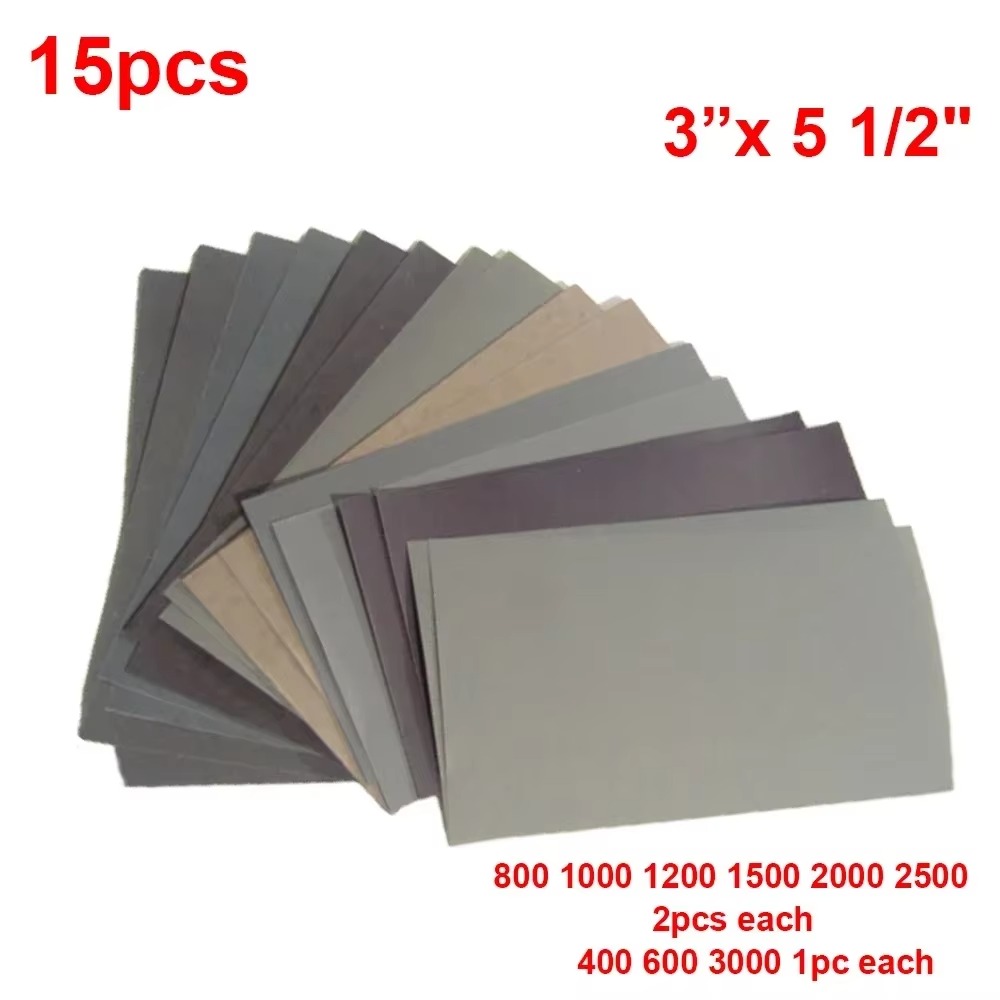
Essential Wet & Dry Sandpaper Set 15pcs

Wool Felt Polishing Wheel Set 5pcs
Detailed Specifications Comparison
| Specification | Wet & Dry Sandpaper Set | Wool Felt Polishing Wheels |
|---|---|---|
| Tool Type | Abrasive sheets — wet and dry | Polishing wheels — rotary tool |
| Grit / Size Range | 400, 600, 800, 1000, 1200, 1500, 2000, 2500, 3000 grit | 3mm – 12mm diameter |
| Piece Count | 15 sheets | 5 wheels |
| Bond / Material | Waterproof resin bond — abrasive particles secured wet or dry | Dense wool felt — polishing compound retention |
| Shank / Compatibility | Cut to fit sanding blocks or power tools | 2.35mm and 3mm shanks — rotary tool and grinding machine |
| Primary Application | Surface preparation, scratch removal, progressive polishing | Final polish, mirror finish, detail and jewelry work |
| Usage Type | Wet and dry — water reduces clogging on fine grits | Used with polishing compounds and pastes |
| Rating | 4.8/5 | 4.7/5 |
Detailed Reviews: Top Abrasive & Polishing Tools
Essential Wet & Dry Sandpaper Set 15pcs — Editor’s Choice
The Essential Wet & Dry Sandpaper Set earns our Editor’s Choice as the foundational abrasive tool for any surface finishing workflow. The logic of a complete grit progression set — rather than purchasing individual grits separately — is that surface finishing is a sequential process where each grit stage must prepare the surface correctly for the next finer stage. A 400-grit sheet that removes deep scratches leaves its own scratch pattern that 800-grit removes; 800-grit’s marks are removed by 1200-grit; and the progression continues until the 3000-grit stage produces a pre-polish surface ready for buffing compounds. Skipping grit stages to save time creates finer scratches on top of coarser ones that only become visible under raking light at the final stage — and require going back to the coarser grit that should not have been skipped.
The waterproof resin bond is the specification that makes this set genuinely dual-purpose rather than simply tolerant of occasional moisture. Wet sanding — using water as a lubricant between the abrasive sheet and the workpiece — produces cleaner finishes on fine grits by carrying removed material away from the cutting surface before it can redeposit as scratches. On the 2000-grit and above sheets where the grit particles are fine enough that debris redeposition is a significant issue, wet use produces measurably superior results compared to dry sanding the same grit. The resin bond prevents the backing from delaminating and the abrasive from releasing under continuous water exposure, which cheaper wet-or-dry papers fail to do after brief use.
The 15-piece count across nine grit levels — providing multiple sheets of the most commonly used mid-range grits — ensures that when a sheet loads or tears during an intensive sanding session, a fresh replacement is immediately available without pausing the project. The sheets can be cut to fit sanding blocks, orbital sander pads, or hand-wrapped around foam backing for curved surface work. The limitation to smaller individual sheet size means large flat panels require more passes, but for the detail and precision work that characterizes metalworking and finishing applications, the sheet dimensions are appropriate to the task.
Key Specifications
- Grit Levels: 400, 600, 800, 1000, 1200, 1500, 2000, 2500, 3000 — complete progression from rough to mirror-prep
- Piece Count: 15 sheets — multiples of most-used grits for session continuity without restocking
- Bond: Waterproof resin — abrasive particle retention through full wet sanding sessions
- Usage: Wet and dry — water use on fine grits produces cleaner finishes by carrying debris clear
- Compatibility: Cut to fit sanding blocks, orbital pads, hand sanding, and foam backing
- Target Materials: Metal, paint, lacquer, plastic, wood — any surface requiring progressive grit finishing
Best Use Cases
- Progressive grit metal surface preparation from 400-grit scratch removal through 3000-grit pre-polish
- Automotive and motorcycle paint finishing where wet sanding with fine grits produces competitive results
- Machined part surface finish improvement before polishing compound application
- Jewelry and small hardware finishing requiring fine grit control in a compact sheet format
- Lacquer and clear coat surface preparation and defect removal in finishing and restoration work
- Any workshop where building a complete grit progression from a single $3.46 purchase makes sense
Wool Felt Polishing Wheel Set 5pcs — Best Polishing Wheels
The Wool Felt Polishing Wheel Set earns the Best Polishing Wheels position as the essential final-stage finishing tool that converts a 3000-grit sanded surface into a mirror finish. The transition from fine sandpaper to polishing compound requires a wheel material that can carry and release polishing compound evenly across the workpiece surface — a characteristic that wool felt provides more effectively than synthetic foam or rubberized abrasive alternatives because the natural fiber matrix holds the compound in suspension rather than absorbing it or depositing it unevenly.
The dense wool construction provides a polishing action that is gentle but mechanically effective: firm enough to maintain consistent compound contact pressure across the surface, compliant enough to conform to slight surface curvature without applying concentrated pressure at contact edges that would create polishing lines rather than a uniform finish. On delicate metal parts, jewelry, and small hardware where aggressive abrasive contact would remove material or cause damage, the wool felt’s natural fiber compliance distributes polishing force in a way that synthetic materials cannot replicate consistently.
The 3mm to 12mm size range across the five-wheel set provides access to the range of surface geometries that precision finishing requires — 3mm and 5mm wheels for intricate recesses, gear teeth, and jewelry detail work; 8mm and 10mm for small hardware surfaces and machined flat areas; 12mm for general surface buffing where coverage speed matters more than access to tight spaces. The availability of both 2.35mm and 3mm shank formats in the set covers the two standard rotary tool collet sizes used globally — the same compatibility range as the rubber abrasive grinding heads. Frequent cleaning between polishing compound applications maintains the wool fiber’s compound retention performance and prevents cross-contamination from one compound grade affecting the next stage.
“Polishing is not just about removing scratches; it is about revealing the hidden character of the material through patience and the right touch.”
Key Specifications
- Material: Dense wool felt — natural fiber compound retention superior to synthetic foam alternatives
- Sizes: 3mm, 5mm, 6mm, 8mm, 10mm, 12mm — detail work through general surface buffing
- Shanks: 2.35mm and 3mm — compatible with standard precision rotary tools and Dremel-compatible range
- Piece Count: 5 wheels — size variety for different surface geometry and access requirements
- Use With: Polishing compounds, buffing pastes, metal polishes, and mirror finish compounds
- Maintenance: Clean between compound grades — prevents cross-contamination that degrades finish quality
Best Use Cases
- Final mirror polish stage after 3000-grit wet sanding — the natural progression from the sandpaper set
- Jewelry and small metal hardware polishing where wheel size variety provides detail and general access
- Intricate recess and gear tooth polishing using 3mm and 5mm wheels that larger pads cannot reach
- Machined part surface finishing to mirror standard for display, photography, or close-tolerance mating
- Knife and blade polishing where wool felt compound retention produces consistent edge-adjacent finish
- Any finishing workflow where the final polishing stage requires a natural fiber wheel over synthetic alternatives
Abrasive & Polishing Tools Buying Guide 2026
Achieving a professional surface finish requires understanding the complete workflow from initial stock removal to final polish — and selecting tools appropriate to each stage rather than expecting any single tool to cover the full progression.
The Grit Progression — Why Skipping Stages Costs Time
The most common surface finishing mistake is skipping grit stages to save time. Each grit level removes the scratch pattern left by the previous coarser grit and replaces it with its own finer scratch pattern. If a 400-grit scratch pattern is followed directly by 1200-grit, the finer grit cannot remove the deeper 400-grit scratches in reasonable time — it only creates a mixed surface of deep and fine scratches that becomes visible as an uneven finish at the polishing stage. The correct approach is a logical step progression: 400 → 600 → 800 → 1000 → 1200 → 1500 → 2000 → 2500 → 3000 for metalwork destined for polishing compound. Each stage typically takes less time than the previous because the scratches being removed are shallower — the total time investment is lower than repeatedly attempting to skip stages and backtracking.
Wet vs Dry Sanding — When to Use Each
Dry sanding is appropriate for coarser grits (400–800) where removing material quickly is the priority and the coarse grit particles are large enough that debris redeposition is not a significant concern. Wet sanding with water produces superior results from 1000-grit and finer — the water carries removed material continuously away from the abrasive surface, preventing the fine particles from redepositing as scratches and keeping the grit cutting cleanly rather than loading. The difference in finish quality between dry and wet sanding at 2000 and 3000 grit is visible and significant — wet produces a consistently finer scratch pattern that polishing compounds can convert to a mirror finish in fewer passes. The waterproof resin bond of the sandpaper set makes this technique fully practical without the sheet degradation that non-waterproof backing causes.
Selecting Polishing Compounds for Wool Felt Wheels
Wool felt wheels require polishing compound to perform their finishing function — the felt fiber provides the carrier and delivery mechanism, but the abrasive particles suspended in the compound do the actual work. For the final mirror finish stage after 3000-grit sandpaper, a fine metal polish or jeweler’s rouge applied to the felt wheel produces the mirror result. For an intermediate stage between 3000-grit and final mirror polish — useful when the 3000-grit scratch pattern is deeper than expected — a medium cutting compound removes the sandpaper marks before the final fine polish stage. Use a dedicated wheel for each compound grade and clean wheels thoroughly before changing compound — residual coarser compound on a wheel used with fine polish reintroduces coarser abrasion that defeats the purpose of the fine stage. Store wheels in a clean container between sessions to prevent contamination from workshop dust and abrasive particles.
Our Final Recommendations
The Wet & Dry Sandpaper Set and the Wool Felt Polishing Wheel Set form a complete surface finishing system — sandpaper takes the surface from rough to 3000-grit pre-polish, and the felt wheels with polishing compound complete the progression to mirror finish. Together at a combined cost of $4.43, they provide the full two-stage finishing capability that professional surface quality requires at a price that makes restocking consumables as needed entirely practical.
For metalworking, machined part finishing, jewelry, and any application where surface appearance is part of the quality standard, these two tools are the foundational abrasive investments that make every other workshop operation’s results visible at their best. The quality of a surface finish is ultimately determined by the care taken at the abrasive stage — no polishing compound can compensate for inadequate preparation, and no amount of cutting can replace the finishing step that reveals the workpiece beneath.
![Best drill bits and step drills from AliExpress [year] on a workshop workbench showing different bit types](https://bestfindo.com/wp-content/uploads/2026/04/best-drill-bits-step-drills-from-aliexpress-2026.jpeg)